SimMark: A Robust Sentence-Level
Similarity-Based Watermarking Algorithm for Large Language Models

Department of Electrical and Computer Engineering, University of British Columbia, Vancouver, BC, Canada

SimMark: A Robust Sentence-Level Similarity-Based Watermarking Algorithm for Large Language Models was accepted to the EMNLP 2025 Main Conference and selected for an Oral Presentation (325/8,174 submissions; 3.98%).

Abstract

The widespread adoption of large language models (LLMs) necessitates reliable methods to detect LLM-generated text. We introduce SimMark, a robust sentence-level watermarking algorithm that makes LLMs' outputs traceable without requiring access to model internals, making it compatible with both open and API-based LLMs. By leveraging the similarity of semantic sentence embeddings combined with rejection sampling to embed detectable statistical patterns imperceptible to humans, and employing a soft counting mechanism, SimMark achieves robustness against paraphrasing attacks. Experimental results demonstrate that SimMark sets a new benchmark for robust watermarking of LLM-generated content, surpassing prior sentence-level watermarking techniques in robustness, sampling efficiency, and applicability across diverse domains, all while maintaining the text quality and fluency.
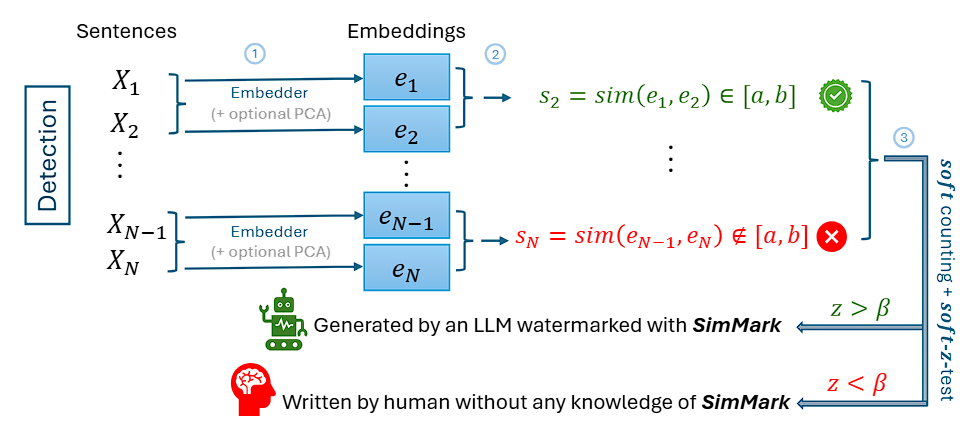
Teaser Image
Figure 1: A high-level overview of SimMark detection algorithm. The input text is divided into individual sentences \( X_1 \) to \( X_N \), which are embedded using a semantic embedding model. The similarity between consecutive sentence embeddings is computed. Sentences with similarities within a predefined interval \( [a, b] \) are considered valid, while those outside are invalid. A statistical test is performed using the count of valid sentences to determine whether the text is watermarked.

Overview of SimMark: A Similarity-Based Watermark
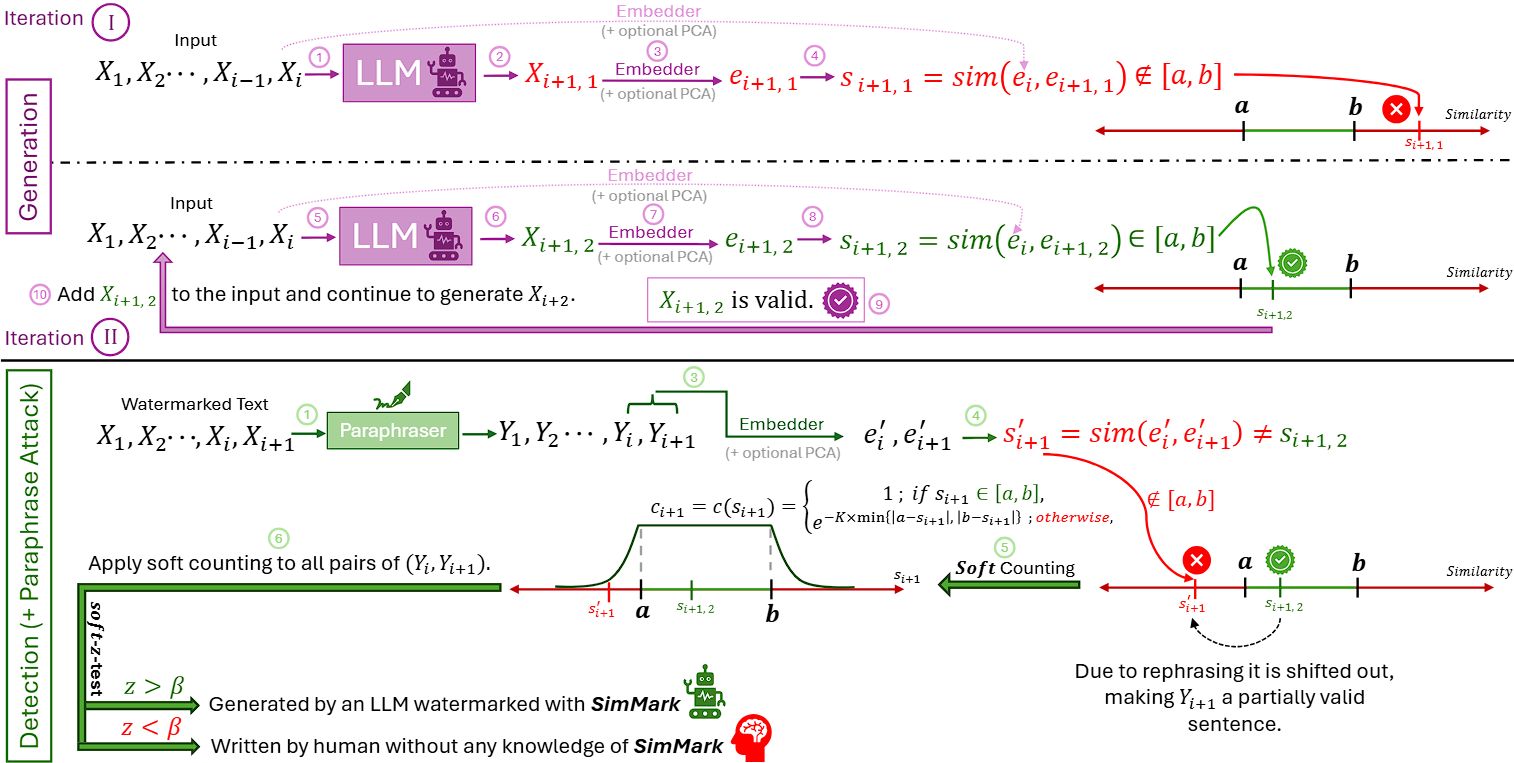
SimMark Image
Figure 2: Top: Generation. For each newly generated sentence \( X_{i+1} \), its embedding \( e_{i+1} \) is computed using a semantic embedding model, optionally applying PCA for dimensionality reduction. The cosine similarity (or Euclidean distance) between \( e_{i+1} \) and the embedding of the previous sentence \( e_i \), denoted as \( s_{i+1} \), is calculated. If \( s_{i+1} \) lies within the predefined interval \( [a, b] \), the sentence is marked valid and accepted. Otherwise, rejection sampling generates a new candidate sentence until validity is achieved or the iteration limit is reached. Once a sentence is accepted, the process repeats for subsequent sentences. Bottom: Detection (+ Paraphrase attack). Paraphrased versions of watermarked sentences are generated (\( Y_{i} \)), and their embeddings (\( e'_{i} \)) are computed. The similarity between consecutive sentences in the paraphrased text is evaluated. If paraphrasing causes the similarity (\( s'_{i+1} \)) to fall outside \( [a, b] \), it is mismarked as invalid. A soft counting mechanism (via function \( c(s_{i+1}) \) instead of a regular counting with a step function in the interval \( [a, b] \)) quantifies partial validity based on proximity to the interval bounds, enabling detection of watermarked text via the soft-\( z \)-test even under paraphrase attacks. It should be noted that soft counting is always applied, as we cannot assume prior knowledge of paraphrasing.

Detection Performance

Detection Table
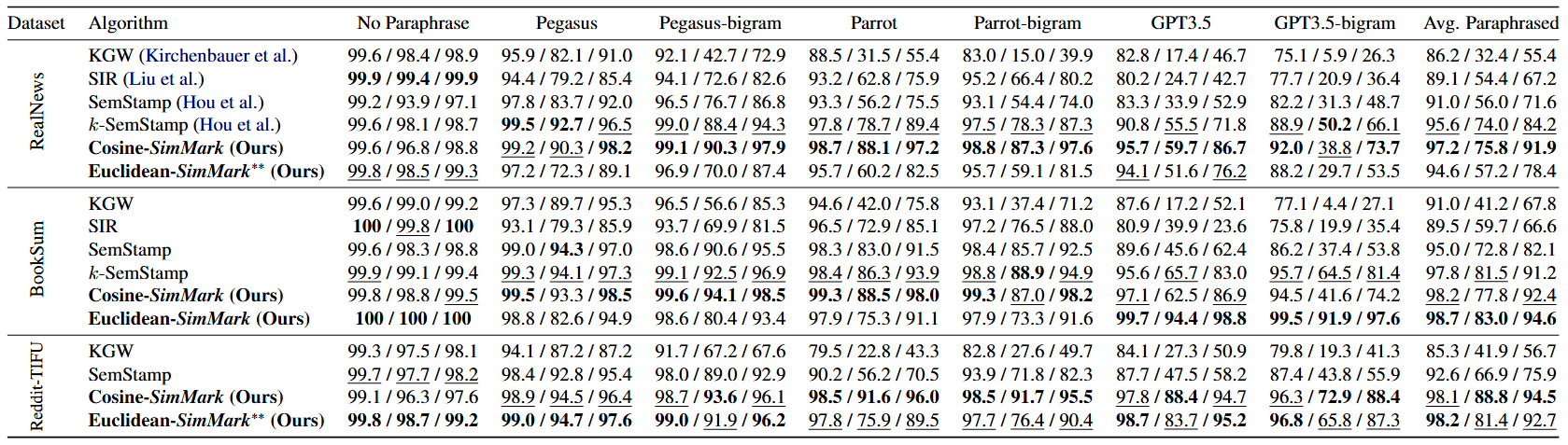
Table 1: Performance of different algorithms across datasets and paraphrasers, evaluated using ROC-AUC↑, TP@FP=1%↑, and TP@FP=5%↑, respectively (↑: higher is better), reported from left to right. Higher values indicate better performance across all metrics. In each column, bold values indicate the best performance for a given dataset and metric, while underlined values denote the second-best. SimMark consistently outperforms or is on par with other state-of-the-art methods across datasets and paraphrasers, and it is the best on average.
Detection Radar Plot
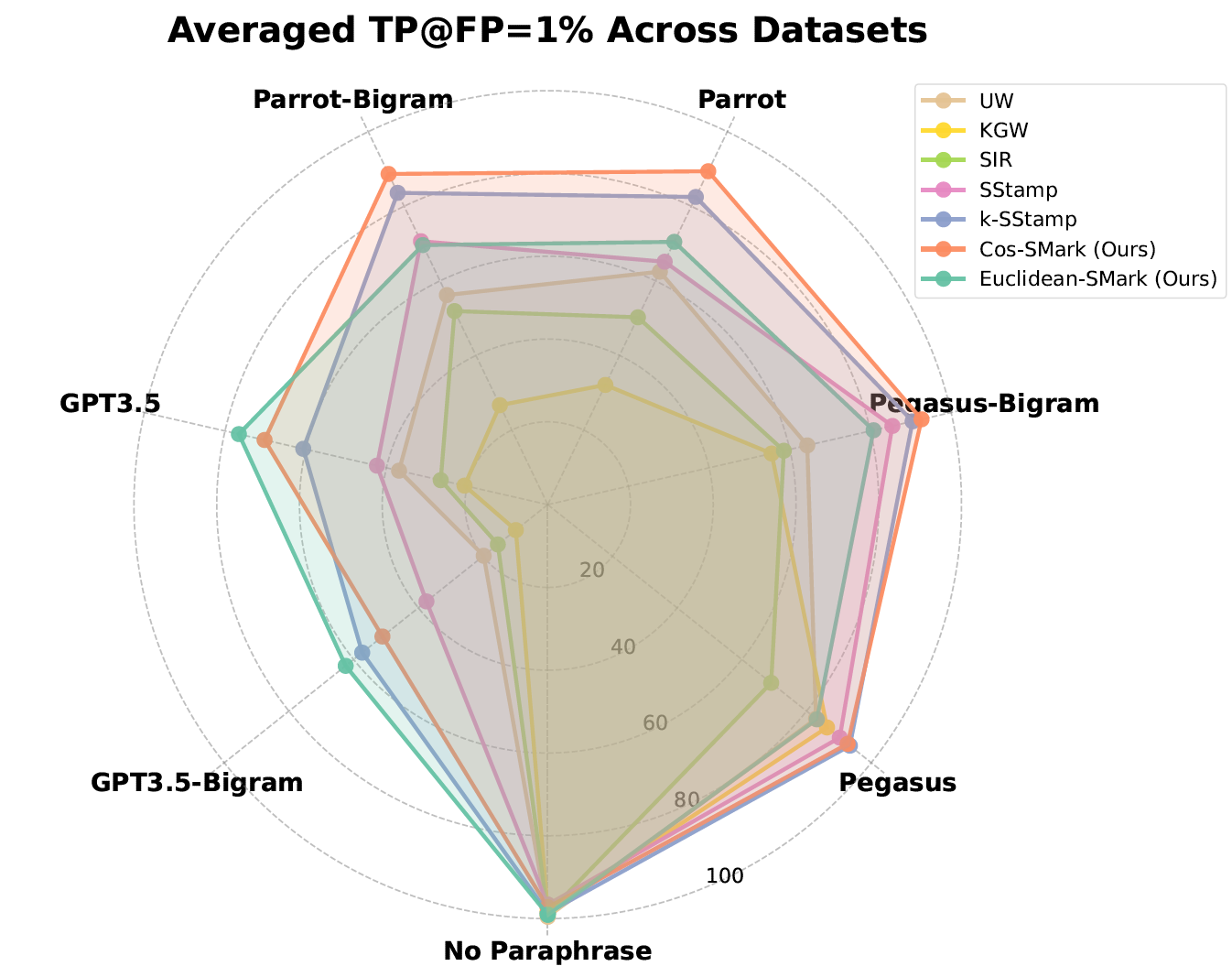
Figure 3: Detection performance of different watermarking methods under various paraphrasing attacks, measured by TP@FP=1% ↑ and averaged across all three datasets (RealNews, BookSum, Reddit-TIFU). Each axis corresponds to a specific paraphrasing attack method (e.g., Pegasus-Bigram), and higher values are better. Our methods, cosine-SimMark and Euclidean-SimMark, consistently outperform or match baselines across most paraphrasers, especially under more challenging conditions such as bigram-level paraphrasing.

Examples of Watermarked Text

Example 1 Image
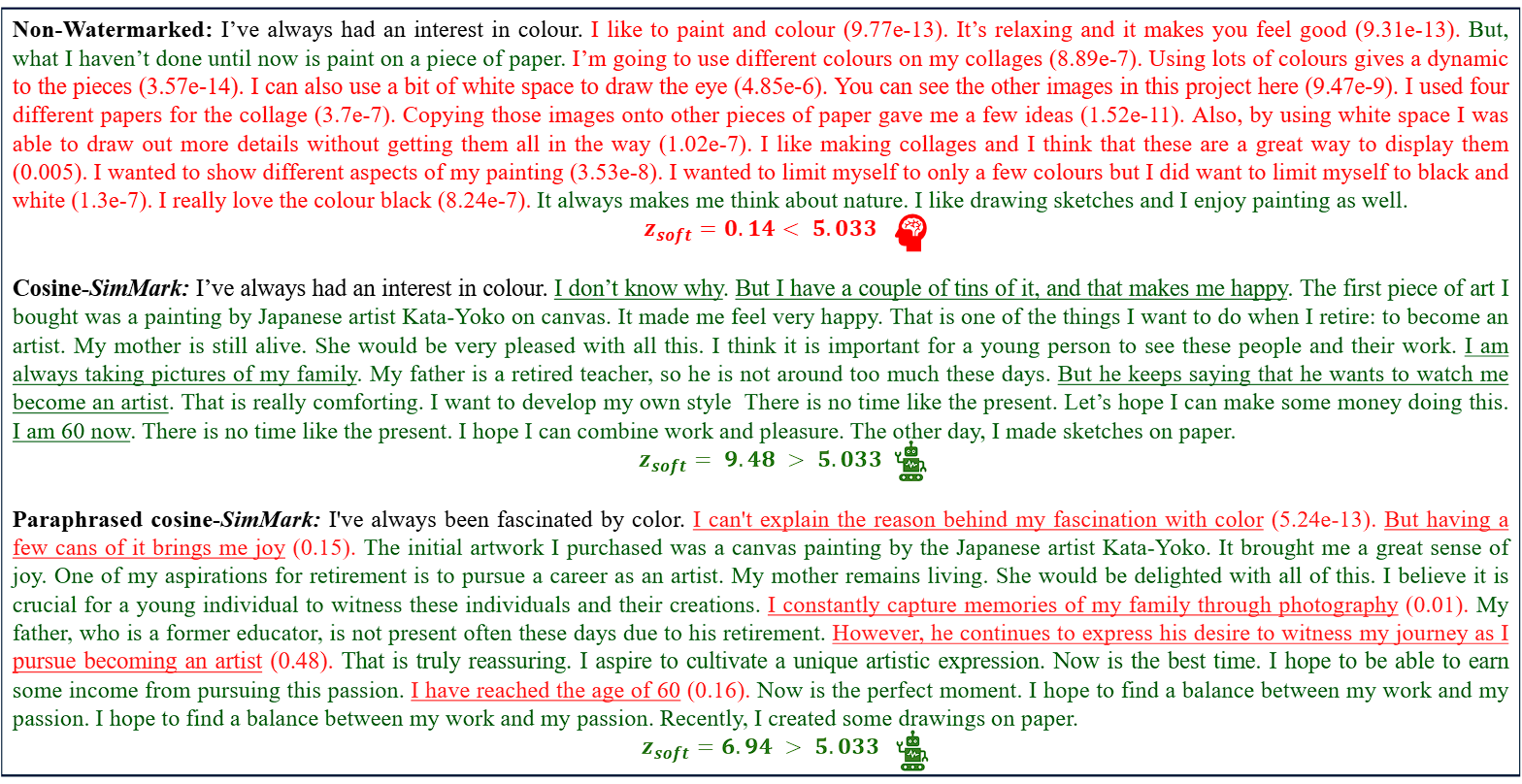
Figure 4: Example of text generated with and without cosine-SimMark using the BookSum dataset. The first sentence (in black) is the prompt for the model, the green sentences are valid, and red sentences are invalid/partially valid. Numbers in parentheses represent the soft count for partially valid sentences. The top panel shows the non-watermarked text, which fails to produce a significant detection signal (`z_{\text{soft}} = 0.14 \color{Red}{<} 5.033`, false negative). The middle panel demonstrates text generated using SimMark with cosine similarity-based watermarking, producing a strong detection signal `(z_{\text{soft}} = 9.48 \color{ForestGreen}{>} 5.033)`. The bottom panel shows paraphrased watermarked text using GPT-3.5-Turbo, where the embedded watermark remains detectable despite semantic alterations `(z_{\text{soft}} = 6.94 \color{ForestGreen}{>} 5.033)`.
Example 2 Image
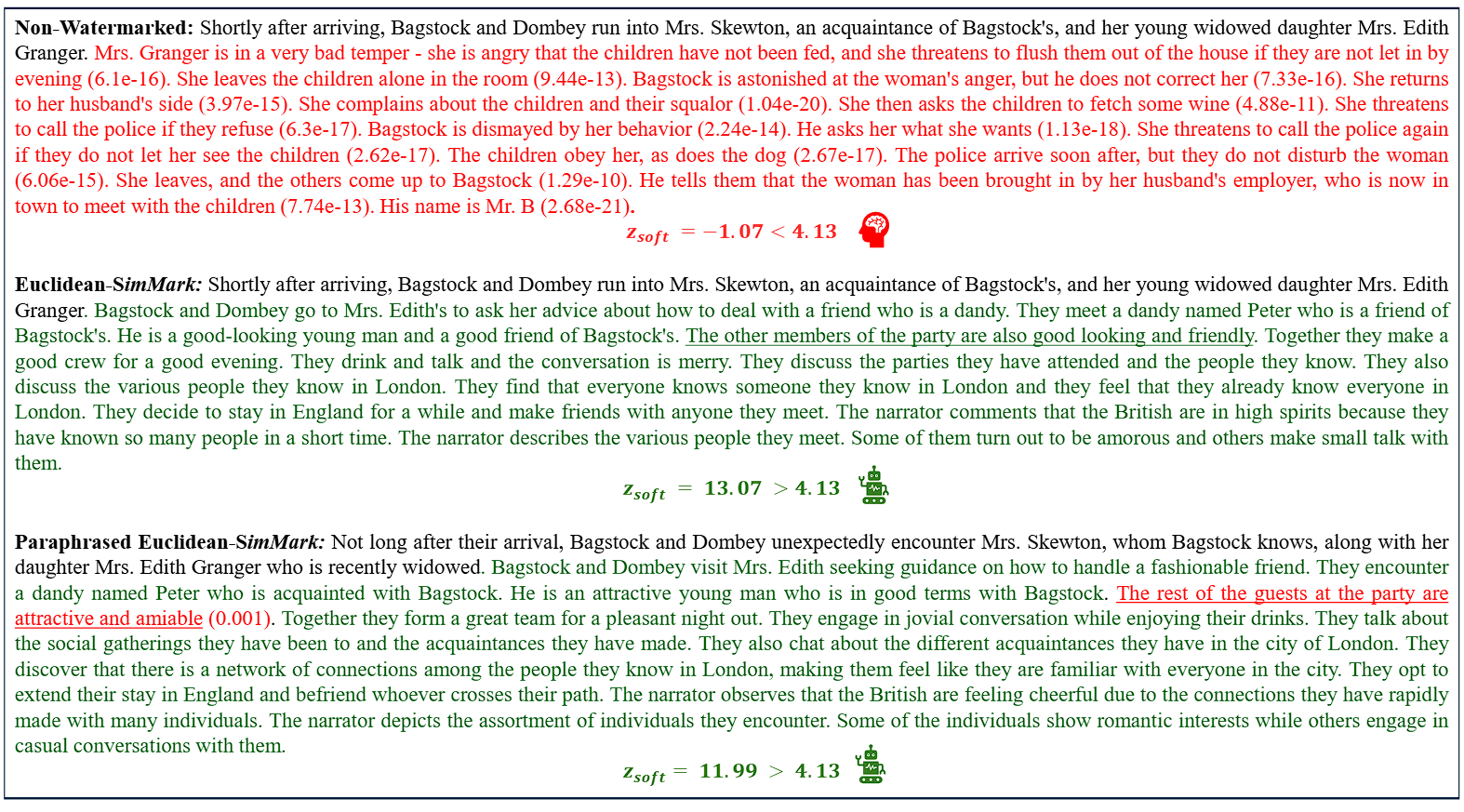
Figure 5: Example of text generated with and without Euclidean-SimMark using the BookSum dataset. The first sentence (in black) is the prompt for the model, the green sentences are valid, and red sentences are invalid/partially valid. Numbers in parentheses represent the soft count for partially valid sentences. The top panel shows the non-watermarked text, which fails to produce a significant detection signal (`z_{\text{soft}} = -1.07 \color{Red}{<} 4.13`, false negative). The middle panel demonstrates text generated using SimMark with Euclidean distance-based watermarking, producing a strong detection signal `(z_{\text{soft}} = 13.07 \color{ForestGreen}{>} 4.13)`. The bottom panel shows paraphrased watermarked text using GPT-3.5-Turbo, where the embedded watermark remains detectable despite semantic alterations `(z_{\text{soft}} = 11.99 \color{ForestGreen}{>} 4.13)`.

BibTeX

If you find SimMark useful in your research, please cite our paper:
@inproceedings{dabiriaghdam-wang-2025-simmark,
    title = "{S}im{M}ark: A Robust Sentence-Level Similarity-Based Watermarking Algorithm for Large Language Models",
    author = "Dabiriaghdam, Amirhossein  and
      Wang, Lele",
    editor = "Christodoulopoulos, Christos  and
      Chakraborty, Tanmoy  and
      Rose, Carolyn  and
      Peng, Violet",
    booktitle = "Proceedings of the 2025 Conference on Empirical Methods in Natural Language Processing",
    month = nov,
    year = "2025",
    address = "Suzhou, China",
    publisher = "Association for Computational Linguistics",
    url = "https://aclanthology.org/2025.emnlp-main.1567/",
    doi = "10.18653/v1/2025.emnlp-main.1567",
    pages = "30785--30806",
    ISBN = "979-8-89176-332-6"
}